
Frequently, when children first arrive at our programme they ask about the sorts of things we do and axe work is innevitably brought up. As I carefully explain our policy around axe use, they can quickly become crestfallen and we have lost young people from our provision as a result of our stance.
More than once when asking young people their experiences of axe work with other providers they have told me that they have just taken them into the woods and cut stuff with them. Of course this may not be true but on more than one occaision, when I have highlighted my concerns, I have been reassured that it was fine because. “It wasn’t sharp”.
That response should stop us in our tracks because it reveals something far more important than a misunderstanding of tools. It reveals how casually high-consequence equipment is being framed in parts of outdoor education.
Somewhere along the line, axes have started to drift into normalised children’s activity and the uncomfortable question is no longer theoretical, it is practical:
When I speak to other experienced providers, I hear similar concerns, similar observations and a similar unease. Not about whether young people should be given tools, but about how quickly expectation, exposure, and confidence appear to be outpacing genuine competence.
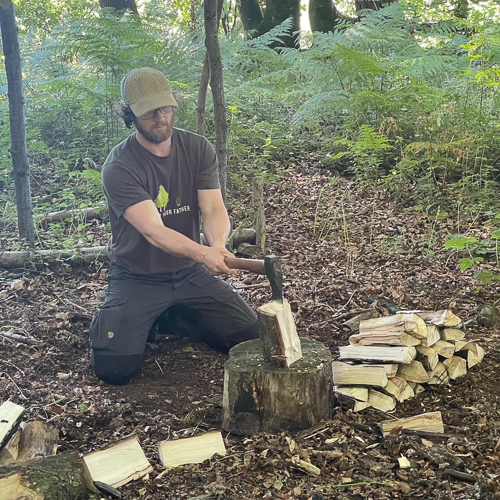
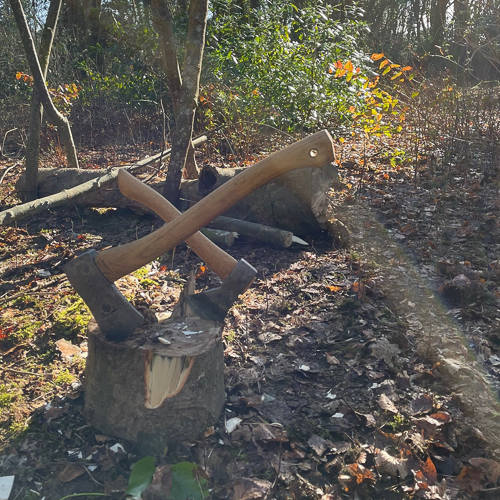
CONFIDENCE IS NOT COMPETENCE
One of the biggest challenges in outdoor education is that familiarity gets mistaken for skill.
A child who has held an axe a few times may genuinely believe they are capable with it. They may even describe themselves as experienced. Adults around them may reinforce that belief, unintentionally or otherwise.
But holding a tool is not the same as understanding it, Real competence takes time, repetition, correction, restraint, and judgement.
It includes:
- reading timber and grain direction
- body positioning and balance
- controlled force application
- awareness of rebound and glancing blows
- safe working zones
- tool maintenance
- fatigue recognition
- …and critically, knowing when not to swing
That last point is often overlooked because competence is not just about understanding how to take action, it is about restraint.
Restraint is rarely visible in the kind of fast-paced, experience-led outdoor activity that has become increasingly common.
The phrase “Don’t worry, it wasn’t sharp” is concerning because sharpness is the only variable that matters – it isn’t.
A blunt axe can still cause catastrophic injury. It is usually less predictable, requiring more force and offering less control. The physics do not change because the edge is dulled but the perception of the tool does and perception drives behaviour.

THE GAMIFICATION OF TOOLS
Axes are no longer just tools in many outdoor settings they have become symbols because they photograph well. They look adventurous, Primitive, Authentic and Powerful.
Social media has amplified this dramatically. Axe throwing has become entertainment and bushcraft clips are edited for impact. Outdoor content increasingly prioritises visual appeal over technical depth.
To be fair, axe throwing is a huge amount of fun. In the right setting, with the right controls, it is enjoyable, engaging, and commercially successful for a reason but I think it has also subtly changed public perception of what an axe is.
Once a tool becomes entertainment, the relationship people have with it changes. The axe shifts from being viewed primarily as a serious processing tool requiring discipline and restraint, into something associated with excitement, novelty, and experience.
The axe has become aesthetic.
For many young people, axes are no longer seen as specialist tools requiring structured progression and careful judgement. They are seen as part of the outdoor experience, something you do outdoors and something to try and “have a go at.”
That shift is subtle, but significant because culture shapes behaviour long before instruction does.